SDK / package reference
Overview
Refract's SDK is a set of packages that compose into a pipeline: ingest → analyze → persist.
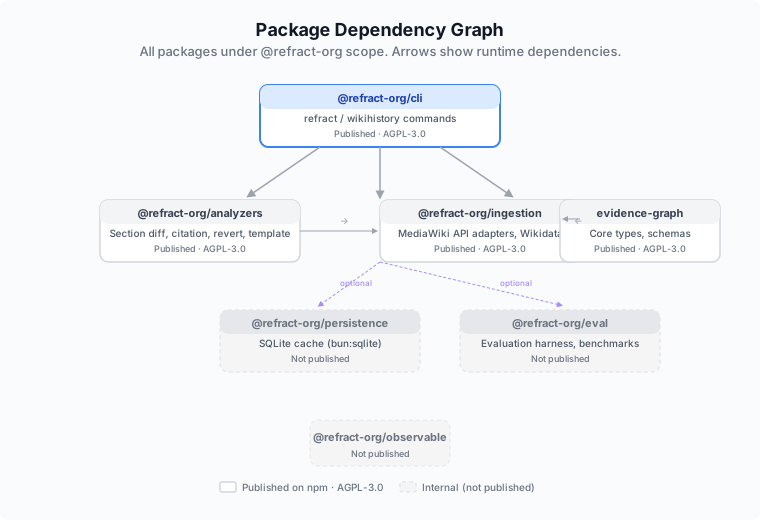
Packages are published on npm under the @refract-org scope, except @refract-org/persistence. All packages are ESM-only and written in TypeScript.
Basic pipeline
The events refract analyze produces, from revisions you fetch yourself. buildRevisionEvents and annotateEvents need @refract-org/analyzers 0.5.1 or later.
import { MediaWikiClient } from "@refract-org/ingestion";
import { annotateEvents, buildRevisionEvents } from "@refract-org/analyzers";
import { createEventIdentity } from "@refract-org/evidence-graph";

const client = new MediaWikiClient({ apiUrl: "https://en.wikipedia.org/w/api.php" });
const revisions = await client.fetchRevisions("Earth", { limit: 50 }); // the 50 latest

// Section, citation, wikilink, category, template, revert and sentence events
// for each consecutive pair of revisions, ordered by timestamp.
const events = annotateEvents(buildRevisionEvents(revisions));
for (const event of events) event.eventId = createEventIdentity(event);
annotateEvents adds schemaVersion and the semantic fields the CLI's output carries (certaintyProfile, directionSignal, quantitativeFindings and others). buildRevisionEvents takes depth ("brief", "detailed", "forensic"), similarityThreshold and the page's protectionLogs. It reads no network and no filesystem, so it runs in a Worker too (with nodejs_compat). For page moves and talk-page correlation as well, follow the recipe in the analyzers README.
Storage
@refract-org/persistence is not on npm: import it from a source checkout, under Bun.
import { Persistence } from "@refract-org/persistence";

const db = new Persistence({ dbPath: "refract.db" });
await db.insertEvents(events);
const saved = await db.getEvents({ pageTitle: "Earth" });
Package reference
@refract-org/evidence-graph
Core types, event schemas, and utilities. Zero runtime dependencies.
import type { EvidenceEvent, EventType, Revision, ClaimLedger, ClaimLedgerEntry, ObservationReport } from "@refract-org/evidence-graph";
import { createClaimIdentity, createEventIdentity } from "@refract-org/evidence-graph";
EventType now includes sentence_modified (26 event types total).
Key exports:
- Interfaces:
EvidenceEvent,Revision,DeterministicFact,ModelInterpretation,ClaimLedger,ClaimLedgerEntry,ObservationReport - Types:
EventType,EvidenceLayer,PolicyDimension,Depth,AnalyzerConfig - Utilities:
createClaimIdentity,createEventIdentity - Merkle tree:
createReplayManifest,buildMerkleTree,getMerkleProof,verifyMerkleProof AnalyzerConfig: configurable thresholds and windows for analyzers — similarity threshold for sentence matching, time windows for clusters and talk correlation, revert patterns, spike factors. Consumers pass their own config at each boundary; Refract records the effective parameters inFactProvenance.parameters.DEFAULT_ANALYZER_CONFIG: frozen default values for all configurable parametersFactProvenance.parameters: optional record of analyzer parameters (strings, numbers, booleans) — set when non-default config is used, enabling transparent provenance
No prompt engineering, no interpretation schema — consumers define their own taxonomy at each configurable boundary.
@refract-org/ingestion
Wikimedia API adapters. Fetches revision history and parses wikitext.
import { MediaWikiClient } from "@refract-org/ingestion";
import type { RevisionFetcher, AuthConfig } from "@refract-org/ingestion";

const client = new MediaWikiClient({ apiUrl: "https://en.wikipedia.org/w/api.php" });
const revisions = await client.fetchRevisions("Earth");
Key exports: MediaWikiClient (class), RevisionFetcher (interface), AuthConfig
Wayback Machine, Git and snapshot revision sources:
import {
  WaybackRevisionSource,
  GitRevisionSource,
  SnapshotDirectorySource,
} from "@refract-org/ingestion";

// 1. Ingest snapshots from the Wayback Machine for any public URL
const wayback = new WaybackRevisionSource();
for await (const rev of wayback.revisions("https://example.gov/public-policy")) {
  console.log(rev.timestamp, rev.size);
}

// 2. Ingest commit history from a local Git repository
const git = new GitRevisionSource({ repoPath: "/path/to/repo" });
for await (const rev of git.revisions("specs/standard.md")) {
  console.log(rev.comment, rev.timestamp);
}

// 3. Ingest timestamped document files from a directory
const snapshots = new SnapshotDirectorySource({ baseDir: "/path/to/archives" });
for await (const rev of snapshots.revisions("document-title")) {
  console.log(rev.revId, rev.content.length);
}
Key exports: MediaWikiClient, WaybackRevisionSource, GitRevisionSource, SnapshotDirectorySource, XmlDumpRevisionSource
Wikidata entity mapping:
import { fetchWikidataId, mapPageToEntity, mapPagesToEntities } from "@refract-org/ingestion";
import type { PageToEntityMap, WikidataEntity, WikidataClaim } from "@refract-org/ingestion";

const qid = await fetchWikidataId("Douglas_Adams"); // "Q42"
const mapping = await mapPageToEntity("Douglas_Adams"); // { pageTitle, qid, entity }
Key exports: fetchWikidataId, fetchWikidataEntity, mapPageToEntity, mapPagesToEntities, wikidataEntityToEvents
@refract-org/analyzers
Deterministic analyzers for section diffs, citation tracking, text propagation, revert detection, and template analysis. Exported as lowercase singleton instances and pure analysis functions.
import {
  sectionDiffer,
  citationTracker,
  analyzeCitationNetwork,
  detectTextPropagation,
  revertDetector,
  templateTracker,
} from "@refract-org/analyzers";
Text propagation: the Jaccard similarity of two texts' token shingles, and the verbatim token spans they share:
const result = detectTextPropagation(sourceDocument, targetDocument, {
  minSpanTokens: 8,
  shingleSize: 5,
});

if (result.isSignificantBorrowing) {
  console.log("Shared tokens:", result.sharedTokenCount);
  console.log("Borrowed spans:", result.borrowedSpans);
}
Citation concentration: citation counts per domain and per source, and a Herfindahl-Hirschman index over the domain shares:
const citations = citationTracker.extractCitations(wikitext);
const network = analyzeCitationNetwork(citations);

console.log("Unique sources:", network.uniqueSourceCount);
console.log("Concentration index:", network.sourceConcentrationIndex);
console.log("Domain breakdown:", network.domainDistribution);
All analyzers share a common pattern: extract from wikitext, then diff two extractions. The diffs are change records (SectionChange, CitationChange, TemplateChange), not events; buildRevisionEvents (0.5.1+) turns a revision history into EvidenceEvents. Every analyzer accepts an optional AnalyzerConfig — thresholds, patterns, and windows that can be tuned per domain. The effective config is recorded in each event's FactProvenance.parameters when non-default values are used.
import { sectionDiffer, citationTracker, revertDetector, templateTracker, detectEditClusters } from "@refract-org/analyzers";
import type { SectionDiffer, CitationTracker, RevertDetector, TemplateTracker } from "@refract-org/analyzers";
import type { AnalyzerConfig } from "@refract-org/evidence-graph";

// Configure per-domain thresholds
const config: AnalyzerConfig = {
  section: { similarityThreshold: 0.8 },
  editCluster: { windowMs: 30 * 60 * 1000, minSize: 2 },
};

// Pass alongside standard calls
const changes = sectionDiffer.diffSections(before, after, config.section);
Key exports:
- Event pipeline (0.5.1+):
buildRevisionEvents,annotateEvents, and the per-pair stepsparseContent,computeStructuralDiffs,detectEditorialSignals - Instances:
sectionDiffer,citationTracker,revertDetector,templateTracker,protectionTracker - Builders:
buildSectionLineage,buildSourceLineage,buildClaimLineage,buildWikilinkEvents,buildPageMoveEvents,buildTalkThreadEvents,buildCategoryEvents,buildParamChangeEvents - Classifiers:
classifyHeuristic - Parsers:
sanitizeWikitext,extractHeadingMap,extractWikilinks,extractCategories,countCitations,countKeywordMentions,deriveSectionHeading,findSectionForTextandbuildSectionCharMap(0.5.1+) - Cross-revision:
correlateTalkRevisions,diffObservations,parseTalkThreads,diffTalkThreads,diffTemplateParams,diffCategories,diffWikilinks - Clusters & activity:
detectEditClusters,detectTalkActivitySpikes - Semantic enrichment (v0.5.0+):
computeCertaintyProfile,computeDirectionSignal,computeEditMagnitude,computeContentChange,extractKeyTerms,extractQuantitativeFindings
@refract-org/cli
The refract / wikihistory CLI tool (16 commands: analyze, claim, classify, cron, delegation, diff, eval, explore, export, init, mcp, snapshot, stream, verify, visualize, watch). See CLI reference.
@refract-org/persistence
SQLite storage adapter (uses bun:sqlite). Not published to npm: import it from a
source checkout, under Bun.
import { Persistence } from "@refract-org/persistence";

const db = new Persistence({ dbPath: "refract.db" });
await db.insertEvents(events);
const events = await db.getEvents({ pageTitle: "Earth" });
Key exports: Persistence (class), PersistenceAdapter (interface), PersistenceConfig
Observable Framework data loader
Recipe for embedding Refract queries in Observable Framework dashboards. Copy the loader pattern directly — it is not a published npm package.
import { readFileSync } from "node:fs";

export interface RefractLoaderOptions {
  path: string;
  format?: "json" | "sqlite";
}

export class RefractLoader {
  private path: string;
  private format: "json" | "sqlite";

  constructor(options: RefractLoaderOptions) {
    this.path = options.path;
    this.format = options.format ?? (options.path.endsWith(".db") ? "sqlite" : "json");
  }

  async load(): Promise<Record<string, unknown>> {
    if (this.format === "json") {
      const raw = readFileSync(this.path, "utf-8");
      return JSON.parse(raw) as Record<string, unknown>;
    }
    const { Database } = await import("bun:sqlite");
    const db = new Database(this.path, { readonly: true });
    const events = db.query("SELECT * FROM evidence_events").all();
    const revisions = db.query("SELECT * FROM revisions").all();
    db.close();
    return { events, revisions };
  }
}

export function refractLoader(options: RefractLoaderOptions): RefractLoader {
  return new RefractLoader(options);
}
Usage in Observable:
import { refractLoader } from "./data-loader.ts";
const data = refractLoader({ path: "./bitcoin-analysis.json" });
@refract-org/eval
Evaluation harness for measuring analyzer accuracy against ground truth labels.
import { createEvalHarness, validateAgainstGroundTruth } from "@refract-org/eval";
Key exports: createEvalHarness, validateAgainstGroundTruth, EvalHarness, GROUND_TRUTH_LABELS, getGroundTruthById, getGroundTruthForPage