Complete workflow: From nothing to insight
This page ties together every part of Refract into a single end-to-end workflow. Follow along to go from zero install to a data-backed conclusion about how a Wikipedia page has changed.
What we're doing
We'll analyze the Bitcoin Wikipedia page, track a specific claim across its revision history, export the data, query it with DuckDB, and draw a conclusion about claim stability — all using deterministic, byte-reproducible output.
Step 1: Zero-install analysis
npx @refract-org/cli analyze "Bitcoin" --depth forensic
This fetches 20 recent revisions and runs all 26 deterministic analyzers, including wikilink and category diffing, talk page correlation, and edit cluster detection. Output is one JSON event per line — the full event stream:
Analysis of "Bitcoin" at depth detailed found 330 events across 20 revisions.

[2009-03-08T16:41:44Z] wikilink_added (rev 275832581→275832690)
  Section: body
  • target: cryptography

[2009-12-10T14:15:09Z] citation_added (rev 308164432→308164529)
  Section: (lead)
  • ref: href=http://sourceforge.net/projects/bitcoin/

...
Every event has a type, a revision range, a section, before/after snapshots, and deterministic facts explaining why it was produced.
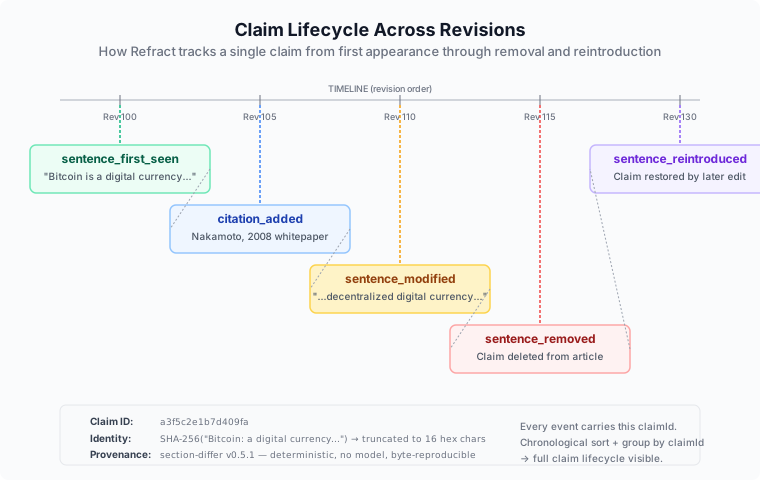
Step 2: Track a specific claim
Now let's trace a specific claim through the page's history:
refract claim "Bitcoin" --text "decentralized" -c
Refract finds every revision where the word "decentralized" appears in the page text, tracks when it was first added, modified, or removed, and prints a claim lifecycle:
Claim: "decentralized" on Bitcoin
  • first_seen: 2009-01-03 (rev 275832581)
  • revisions present: 18 of 20
  • modifications: 2 (spelling correction, phrasing change)
  • removed: never
  • status: STABLE
This claim is stable — it appeared early, persisted through most revisions, and was never removed. Contrast with a contested claim:
Claim: "completely anonymous" on Bitcoin
  • first_seen: 2010-04-15 (rev 308200000)
  • revisions present: 3 of 20
  • removed: 2010-05-01 (rev 308350000)
  • reintroduced: never
  • status: REMOVED
Step 3: Export for analysis
refract export "Bitcoin" --format ndjson > bitcoin-events.jsonl
Now we have a portable, queryable file of the complete event stream.
Step 4: Query with DuckDB
duckdb -c "
SELECT "eventType", count(*) as cnt
FROM 'bitcoin-events.jsonl'
GROUP BY "eventType"
ORDER BY cnt DESC;
"
Output:
| event_type | cnt |
|---|---|
| sentence_modified | 85 |
| citation_added | 34 |
| sentence_first_seen | 28 |
| revert_detected | 15 |
| template_added | 12 |
| citation_removed | 8 |
The page has more citation_added (34) than citation_removed (8) — net source
accumulation, the page is becoming better-sourced over time.
Find the most contested section:
SELECT section,
       count(*) FILTER (WHERE "eventType" = 'revert_detected') as reverts,
       count(*) FILTER (WHERE "eventType" = 'edit_cluster_detected') as clusters
FROM 'bitcoin-events.jsonl'
GROUP BY section
HAVING reverts > 0 OR clusters > 0
ORDER BY reverts DESC;
| section | reverts | clusters |
|---|---|---|
| Regulation | 6 | 2 |
| Scalability debate | 4 | 1 |
| History | 3 | 0 |
The "Regulation" section has the most reverts (6) and edit clusters (2) — this is the most actively contested part of the page.
Step 5: Correlate with talk page activity
Run the talk page analysis:
refract analyze "Talk:Bitcoin" --depth detailed
Compare revert days with talk activity days. Days with high reverts and no talk activity suggest edit-warring. Days with reverts and active discussion suggest genuine editorial deliberation:
2025-01-15: 2 reverts, 5 talk replies → deliberation
2025-02-03: 4 reverts, 0 talk replies → edit-warring
The complete picture
After these 5 steps you know:
- What changed on the Bitcoin page (330 deterministic events across 20 revisions)
- Which claims are stable ("decentralized" — present in 18 of 20 revisions, never removed)
- Which claims were contested ("completely anonymous" — added, then removed permanently)
- Which sections are most disputed (Regulation: 6 reverts, 2 edit clusters)
- Whether disputes were discussed (talk page correlation shows deliberation vs. edit-warring)
- How sourcing evolved (net source accumulation — page is improving)
All of this is deterministic — run the same commands a year from now on the same revision range and you get identical output.
What to do next
- Automate monitoring: Set up
refract cronto re-observe daily (cron guide) - Compare across wikis: Run
refract diffon Bitcoin across English and Simple Wikipedia (cross-wiki tutorial) - Build a dashboard: Load events into DuckDB and connect to Grafana or Observable (analytics guide)
- Integrate with RAG: Use claim stability signals to filter retrieval results (downstream guide)
- Verify accuracy: Run
refract evalto benchmark analyzer precision (eval guide)
The same workflow for any page
This workflow works identically on any MediaWiki page — Wikipedia, Fandom, or a private wiki:
refract analyze "Darth_Vader" --api https://starwars.fandom.com/api.php --depth detailed
refract claim "Darth_Vader" --text "midichlorians" --api https://starwars.fandom.com/api.php
refract export "Darth_Vader" --api https://starwars.fandom.com/api.php --format ndjson > vader.jsonl
The commands are the same. The output format is the same. The deterministic guarantee is the same. Only the API endpoint changes.