Interpreting Refract output
Refract emits a deterministic event stream. This page explains how to read it.
The event envelope
Every event has the same structure:
{
  "eventId": "a3f5c2e1b7d409fa",
  "eventType": "sentence_first_seen",
  "claimId": "c7d8e9f0a1b23456",
  "fromRevisionId": 1280110001,
  "toRevisionId": 1280110100,
  "section": "Geology",
  "before": "",
  "after": "Earth's crust consists of tectonic plates...",
  "deterministicFacts": [
    {
      "fact": "New sentence detected",
      "detail": "First appearance of this text across revision range",
      "provenance": {
        "analyzer": "section-differ",
        "version": "0.5.1",
        "inputHashes": ["sha256:abc123..."]
      }
    }
  ],
  "layer": "observed",
  "timestamp": "2024-11-25T12:00:00Z",
  "schemaVersion": "0.4.0"
}
Field meanings
| Field | What it tells you |
|---|---|
eventType |
Kind of change — sentence, citation, template, revert, section, etc. See event taxonomy. |
fromRevisionId / toRevisionId |
The revision boundary where this change occurred. from is the parent revision; to is the revision containing the change. |
section |
Which section the change belongs to. (lead) means the page introduction. Not all event types use this field. |
before / after |
The text before and after the change. For additions, before is empty. For removals, after is empty. For modifications, both are present. |
deterministicFacts |
Why the engine produced this event. Always mechanical — pure functions of the wikitext. The provenance field identifies which analyzer, what version, and what parameters. |
layer |
Where the evidence came from: "observed" (deterministic), "policy_coded" (rules-based), "model_interpretation" (downstream only), "speculative" (low confidence), "unknown". |
schemaVersion |
Which schema version produced this event. Use this for compatibility checks when consuming events across package versions. |
Event types by category
Claim lifecycle (sentence_*)
These events track propositional content across revisions. A sentence is identified by its text; Refract detects when the same sentence appears, disappears, changes, or returns.
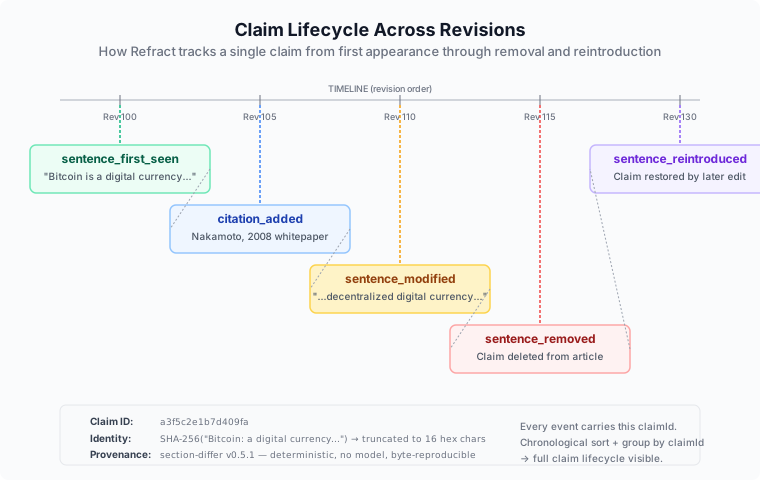
sentence_first_seen: This text has never appeared before in the revision range.sentence_removed: This text was present in the previous revision and is absent now.sentence_modified: The text changed but is similar enough (above the similarity threshold) to be considered the same sentence.sentence_reintroduced: Text that was previously removed has returned.
Source changes (citation_*)
Citations are extracted from <ref> tags in wikitext.
citation_added: A new reference was added.citation_removed: An existing reference was deleted.citation_replaced: One reference was swapped for another at the same position.
Policy signals (template_*)
Templates like {{citation needed}}, {{NPOV}}, {{BLP sources}} are Wikipedia's
dispute signals. Refract tracks them mechanically.
template_added: A template was inserted into the page.template_removed: A template was taken out.template_parameter_changed: A template's parameters were modified (e.g., date updated on a maintenance tag).
Structural changes (section_*, lead_*, page_moved)
section_reorganized: Sections were added, removed, or reordered.lead_promotion: Content was moved from the body into the lead section.lead_demotion: Content was moved from the lead into the body.page_moved: The entire page was renamed.
Dispute signals (revert_*, edit_cluster_*)
revert_detected: An edit was reverted, detected from the edit summary matching revert patterns.edit_cluster_detected: Multiple edits occurred within a tight time window (default: 3+ edits in 1 hour).
Talk page activity (talk_*)
These events correlate article revisions with their associated talk pages.
talk_page_correlated: An article revision has a nearby talk page revision.talk_thread_opened: A new discussion thread was started.talk_thread_archived: A thread was closed or archived.talk_reply_added: A reply was posted in an existing thread.talk_activity_spike: Talk page activity exceeded the threshold (default: 3× the moving average).
Reading patterns across events
Stability signal
A claim that has sentence_first_seen early in the timeline, no sentence_modified
events, and is still present at the end of the revision range is stable.
Contestation signal
A claim with frequent sentence_modified events, revert_detected in its section,
and template_added with dispute templates ({{NPOV}}, {{citation needed}}) is
actively contested.
Source fragility signal
A citation that was added and then removed within a short revision window (or was replaced multiple times) is source-fragile — the page's evidence base for that claim is unstable.
Canon change signal (Fandom wikis)
category_removed immediately followed by category_added with a different category
in the same revision boundary is a canon reclassification. sentence_removed on a
long-standing claim followed by sentence_first_seen with different text in the same
section is a retcon.
Downstream consumption
When building on Refract's event stream:
- Filter by
eventTypeto isolate the signal you care about (e.g., citation events for source churn analysis). - Group by
sectionto find which parts of the page are most active. - Chain by
claimIdto trace a specific proposition across its full lifecycle. - Sort by
timestampto reconstruct the chronological sequence. - Never interpret
layervalues you didn't set —model_interpretationis for downstream use only. Refract never sets it.
The event stream is pure NDJSON — pipe it, filter it, join it, archive it.